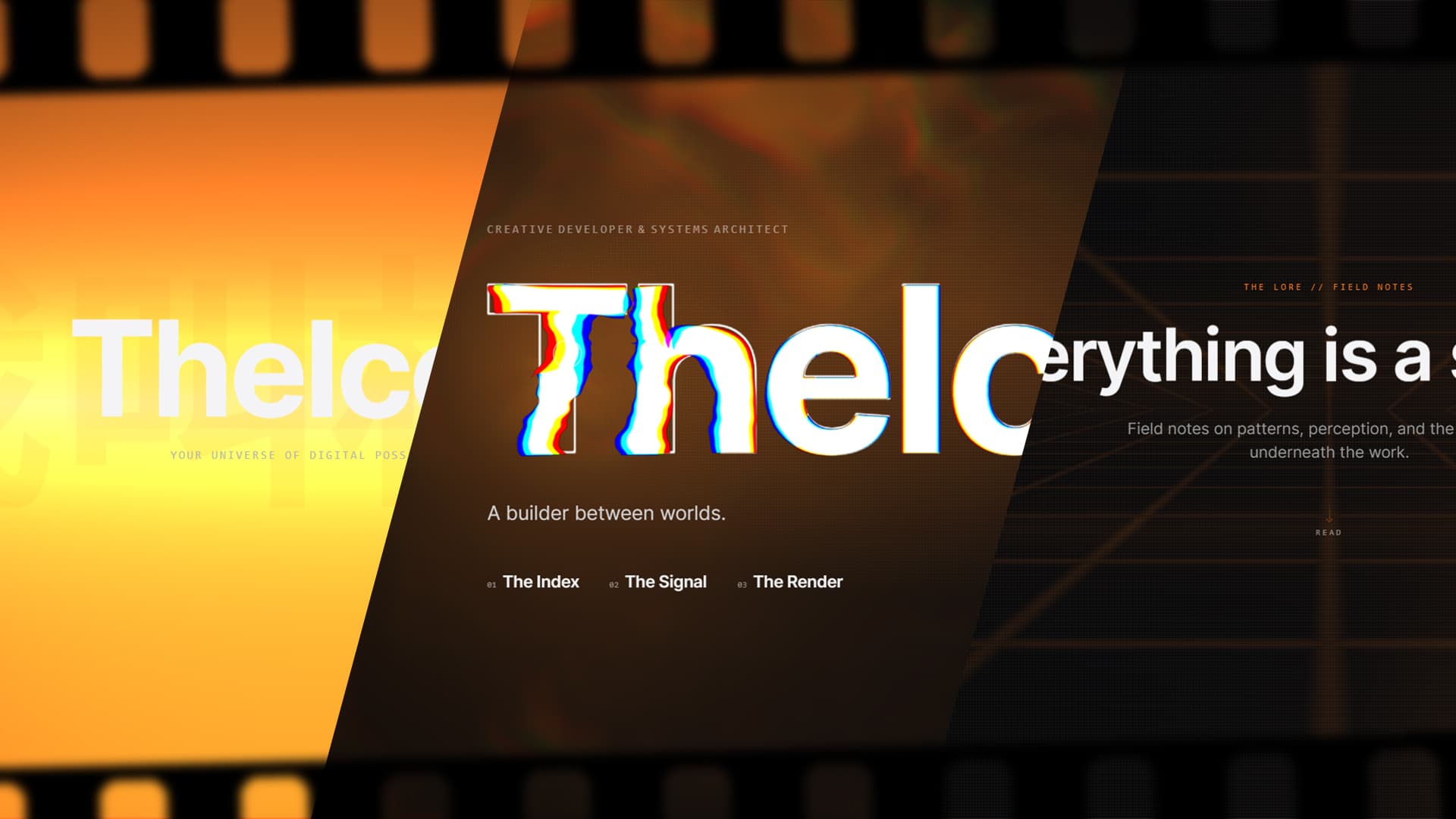
At some point during the About page, I stopped opening Figma and started opening a notebook to sketch shots. That was the tell. I wasn't designing a page anymore — I was storyboarding a film that happens to run in a browser. Six acts, a cold open, a couple of reveals, a resolution. A script.
It sounds pretentious written down. In practice it was the most useful decision I made, because it handed me a tool every other framing lacked: a sense of time.
A page is a list. A film is a journey.
Most portfolios are lists. Here's a hero, here's some work, here's an about blurb, here's a footer. Everything is present at once, ranked by scroll position, and the only verb available to the visitor is “skim.” There's nothing to find out, because everything was already on the table the moment the page loaded.
A film refuses to do that. A film knows that what it withholds is as powerful as what it shows. It sets something up in the first minute that doesn't pay off until the last. It makes you want to know what happens next — and that wanting is the engine that pulls you through. I wanted a portfolio that pulled, not one you had to push yourself down.
Pacing is a feature
Once you're thinking in film, pacing becomes a design material as real as colour or type. Scroll becomes the edit — the rate at which you cut between ideas. Reveals are timed, not dumped. The quiet stretches are deliberate; a beat of near-emptiness is what gives the next moment room to land.
The hardest discipline is refusing to spend everything in the first viewport. The instinct in web design is to front-load — say everything immediately, in case they leave. Film teaches the opposite: earn the next moment, and the visitor will stay for the next moment. A good first act creates a question. It doesn't answer all of them.
Six acts, one arc
The About page runs as six acts, Act 0 through Act V — a cold open that drops you into atmosphere before it explains anything, a rising middle that builds the ideas, and a resolution that lands the point. The arc is deliberately a little mythic, because the subject is, honestly, a person's mind rendering itself into view, frame by frame.
I'm not going to narrate every beat — the page is better experienced than summarised. The structure matters more than the specifics: a beginning that asks, a middle that builds, an end that resolves. The oldest shape there is, applied to a scroll.
A post-production sensibility
The other half of this comes from post-production. If you've ever finished a film, you know the shoot is only the start; the movie is made in post. Editing, colour grade, sound design, compositing — a sequence of disciplined passes, each one deciding something specific, in a deliberate order.
I run a web build through the same passes. Block it out in grey. Light it. Grade the palette until the whole thing agrees on a mood. Score it — sound and motion. Then finalize. The order is the craft; skip a pass and you can feel the seam. It's the same instinct behind treating generative tools as one stage in a pipeline, and behind building a continuous world where the transition is the cut between shots.
Most sites are documents. This one is directed.
Direction is just deciding what matters
Strip away the romance and a director's real job is embarrassingly simple to state and impossibly hard to do: decide where the attention goes. What do we cut to. What do we hold on a beat too long. What's in focus, and what's allowed to blur. Every frame is a claim about what matters most, right now.
That's the same job on a website. Every screen is a frame, and every frame is a decision about where I'm sending your eye. Once I started seeing it that way, “good design” and “good direction” stopped being two skills. They became one.
If you've ever cut a film, you already know how to build a site that breathes — the holds, the cuts, the moment of black before the title. Same craft. New timeline.