It started, like a lot of my ideas, with money. Quant trading, market data, the very normal-sounding desire to find an edge. If you'd asked me then what I was doing, I'd have said “building a trading system.” That answer was true and also completely missed the point of what was actually happening.
Because the thing that hooked me was never the money. It was the data — and a question hiding underneath it that turned out to be far bigger than any trade.
The question under the trade
Everyone in markets asks “will it go up or down?” I found I couldn't stay interested in that question for very long. The one that actually kept me up was structural: can the behaviour of this data be modelled well enough to simulate what comes next? Not “what's the answer,” but “is this thing modellable at all, and how would I know?”
That's a different question with a different shape. “Will it go up” wants a tip. “Can this be simulated” wants a machine — something that ingests history, learns the dynamics, and runs the world forward to see what tends to happen. The day I noticed I was building the machine and not chasing the tip, everything changed.
The realisation that broke it open
Here's the realisation that quietly detonated the whole project. The core of a trading engine isn't trading. Look at what it actually does: it ingests a stream of data, analyses it, simulates possible futures, and predicts. Not one line of that is about finance. Finance was just the data I happened to feed it.
So I asked the obvious, dangerous follow-up. What if I fed it something else? Swap market ticks for sensor readings, for traffic counts, for a climate series, for a supply chain's events. The engine doesn't care. The domain was a costume; the engine was the body underneath. And suddenly “a better trading tool” felt like an absurdly small thing to be building.
The simulation pivot
That's the pivot that reframed everything: from a financial platform to a simulation platform. And it rests on one observation about the world. Most of what we care about can be described as events, flows, signals, states, and time-series. Markets, yes — but also factories, cities, power grids, ecosystems, organisations. They all emit the same kinds of data.
If that's true, then anything you can do in markets you can do anywhere you can get that data. Visualise it. Simulate it. Forecast it. Stress-test it against conditions that haven't happened yet. If you can backtest a trading strategy, there is no reason in principle you can't backtest a factory line, or a logistics network, or a climate intervention.
The ecosystem, in layers
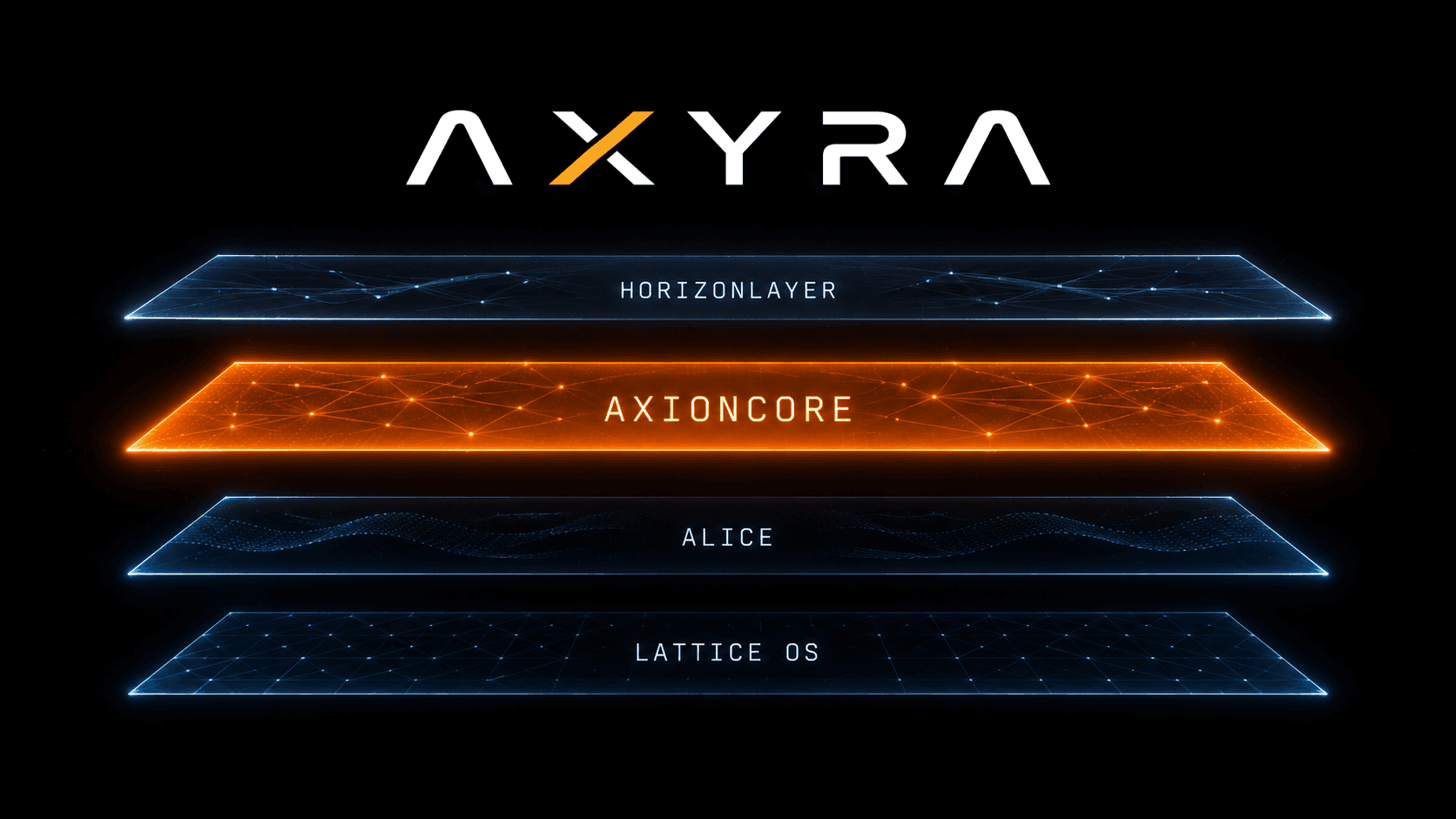
One engine isn't a company, though. To make this real it has to be layered, because the problem is layered. So the ecosystem is built in tiers, each doing one job:
Axyra is the brand and the vision — the umbrella over all of it. HorizonLayer is the connective tissue: the network and protocols that move data between systems so the engine can actually reach it. AxionCore is the engine itself — analysis, simulation, prediction. ALICE is the copilot that sits on top, where AI proposes and the engine verifies. And Lattice OS is the long horizon — an environment where people, AI, and data share one graph. Different layers, one conviction running through all of them.
If you can backtest a market, why not a city? A factory? A climate?
Why start with money at all
People sometimes ask why something this broad started in trading of all places. The answer is that markets are a savage, honest teacher. The feedback is instant and the scoreboard doesn't lie — a bad model loses real money, today, with no excuses. The data is clean, dense, and decades deep. You could not design a better proving ground for the idea that data behaviour can be modelled and simulated.
Markets weren't the destination. They were the dataset honest enough to tell me whether the whole thesis held up.
The trades were never the point. They were the first dataset clean enough to let me prove a much larger idea — to myself, before anyone else — that understanding any system deeply enough means you can simulate its future. Trading just happened to be where the world let me check my work the fastest.