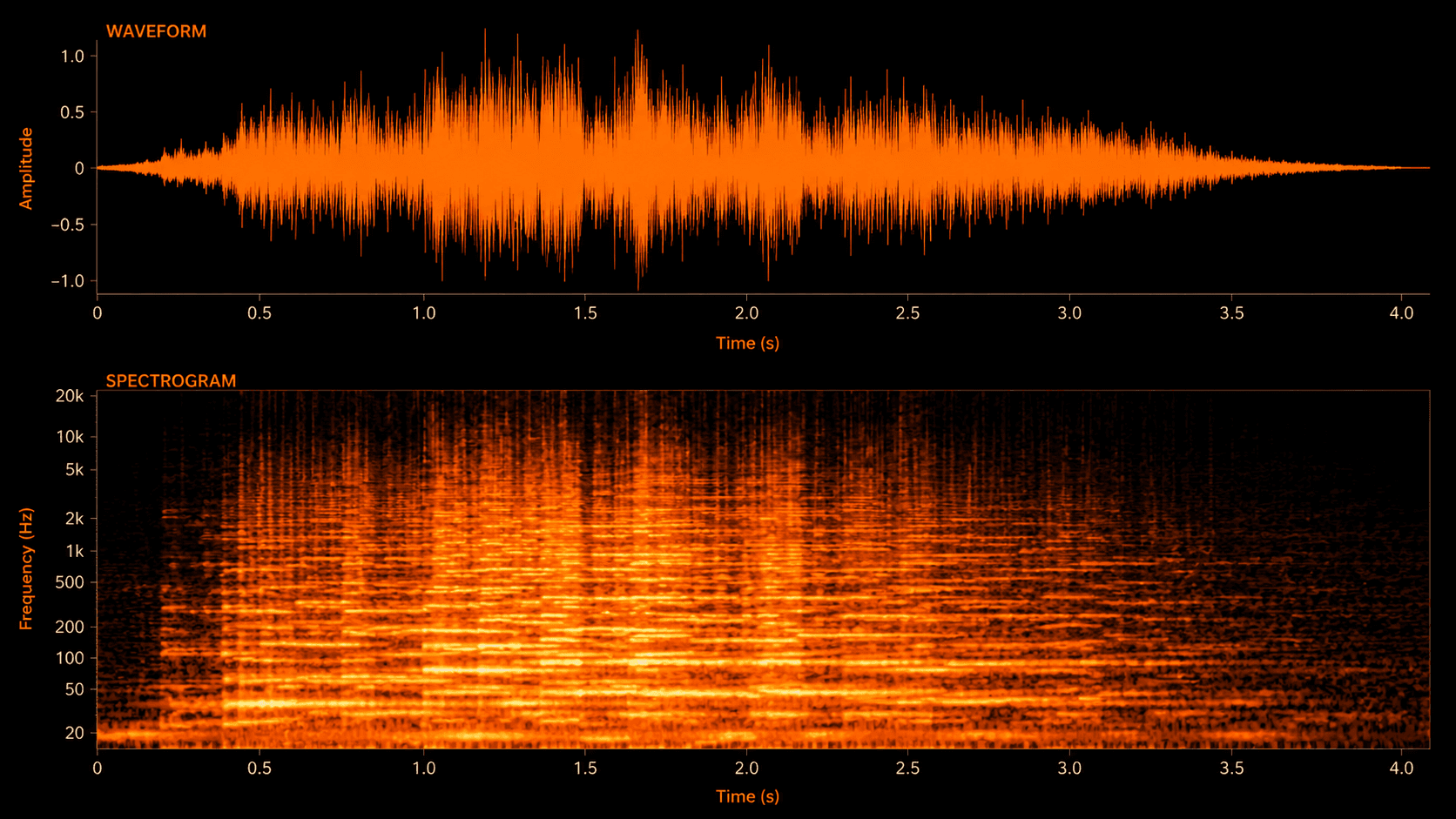
The first time it really hit me, I wasn't thinking about philosophy at all. I'd dragged an audio file into an editor to clean up a hum, and there it was on screen: a long, jagged line breathing across the timeline. Amplitude on the vertical, time on the horizontal.
And I just stopped. Because I had spent the previous week staring at almost exactly that shape — except it had been a price chart. Same peaks, same lulls, same restless texture. Two things with nothing in common, drawn identically. Sound was where the idea stopped being a hunch and started being something I could point at.
A pressure wave, written down
Strip away everything cultural about music and a sound is brutally simple: it's air pressure changing over time. Something vibrates, the air around it compresses and rarefies, and that travelling wobble hits your eardrum. That's it. That's sound.
A digital waveform is just that wobble written down — thousands of measurements a second of “how much pressure, right now.” Which means an audio file is not like a time-series. It is one, in the purest possible form: a single value, sampled over time, no metaphor required.
Two ways to read one sound
What makes audio such a beautiful teacher is that one recording can be read two completely different ways. There's the waveform — amplitude against time, the shape I described above. And there's the spectrum — the same sound decomposed into the frequencies hiding inside it, drawn as a spectrogram.
Flipping between those two views is the exact same move as turning a price series into a volatility series, or a position into a velocity. You haven't changed the data at all. You've changed the lens — and a different lens reveals a different truth that was there the whole time. Learn to switch lenses freely and every signal starts handing you more than it first showed.
Why audio was my first proof
I want to be honest about the order things happened in. I didn't start with a grand theory that everything is a time-series and then go looking for examples. I started with this small, stubborn coincidence — a waveform and a price chart being the same shape — and the theory grew backwards out of it.
Sound was the proof of concept for a much bigger claim. If something as sensual and human as music is, underneath, the same object as something as cold as a market tick, then maybe the pattern goes much further than two examples. Maybe it goes basically everywhere.
Designing the site's sound
That belief is why the audio on this site is built the way it is. Every interaction here has a voice — not a stock click pulled from a library, but a tuned tone with intent. The audio layer treats sound the way the rest of the site treats data: deterministic, generated, and keyed to the same orange carrier signal that runs through everything visual.
The detail I'm proudest of: the same seed that draws a post's waveform signature can also be played. The thing you see and the thing you hear come from one source. Look at the signal, then listen to it. It's the same object, addressed to two different senses.
If you can see a signal, you can hear it. They were never different things.
The same maths, the same beauty
Once you start hearing in time-series, you can't stop. A note has an envelope — attack, decay, sustain, release — and so does a news event rippling through a market. A heartbeat has a rhythm you can read like a drum loop. A climate curve swells and falls with a slow seasonal bassline. The vocabulary of music — peaks, decay, resonance, noise — turns out to describe almost any signal you'll ever meet.
It even bleeds into how I think about perception itself: a continuous sound is really just samples fast enough to fool us, which is uncomfortably close to how I've started to wonder about reality.
A heartbeat, a synth pad, a candlestick chart. Squint, and they rhyme. Listen closely, and they might just be the same song played on different instruments.